
Table of Contents
- The Strategic Role of Chinese HTN Yarn in Global Supply Chains
- Understanding the Product: What Defines High-Tenacity Polyester Yarn?
- Market Landscape: Key Production Clusters and the Wholesale Ecosystem
- Major Wholesalers and Manufacturers: A Tiered Analysis
- Specifications, Grades, and Technical Data: Decoding the Product Sheet
- Pricing Dynamics and Cost Structure Analysis
- Strategic Sourcing: A Guide for Different Buyer Profiles
- Quality Assurance, Inspection, and Risk Mitigation
- Logistics and Supply Chain Considerations
- Future Trends and Industry Outlook
- Building a Reliable Sourcing Channel
- Frequently Asked Questions (FAQ)
1. The Strategic Role of Chinese HTN Yarn in Global Supply Chains
For procurement managers in textiles, industrial fabrics, and consumer goods, securing a reliable supply of high-tenacity (HTN) polyester filament yarn is not just a purchase—it’s a critical investment in product integrity and supply chain resilience. Wholesalers of High-Tenacity Polyester Filament Yarn in China While often unseen, this material forms the backbone of countless products, from the tire cord in your vehicle and the safety belt in an airplane seat to durable luggage and industrial conveyor belts. China has evolved into the world’s dominant producer and exporter of this specialized yarn, offering a combination of scale, technology, and cost-effectiveness unmatched by any other region.
This article is your definitive guide to navigating the wholesale market for Chinese high-tenacity polyester filament yarn. We will move beyond simple supplier listings to provide a comprehensive analysis of the market’s structure, key players, technical specifications, and strategic sourcing approaches. By the end, you will be equipped to identify the right partners, negotiate from a position of knowledge, and build a robust, value-driven supply chain for your technical textile needs.
2. Understanding the Product: What Defines High-Tenacity Polyester Yarn?
High-tenacity polyester filament yarn is engineered for strength, not for aesthetics. It undergoes specialized polymerization, spinning, and drawing processes to orient the polymer chains, resulting in significantly higher tensile strength and lower elongation compared to standard textile-grade polyester yarn.
Core Distinguishing Characteristics:
- High Tensile Strength: Typically ranging from 6.0 to 9.5 grams per denier (g/d), compared to 3.5-5.0 g/d for standard yarn. This is its primary selling point.
- Low Elongation at Break: Usually between 10% and 20%, providing dimensional stability and resistance to stretching under load.
- Excellent Resistance: To abrasion, chemicals, moisture, and UV radiation, ensuring long-term performance in harsh environments.
- High Modulus: Offering stiffness and load-bearing capacity.
3. Market Landscape: Key Production Clusters and the Wholesale Ecosystem
China’s HTN yarn industry is concentrated in several major industrial clusters, each with distinct characteristics:
- Zhejiang Province (Hangzhou, Shaoxing): The undisputed leader, home to integrated petrochemical-to-yarn giants and advanced technology-focused producers. This cluster excels in ultra-high tenacity yarns for tire cord and premium industrial applications.
- Jiangsu Province (Wuxi, Suzhou): A major hub with a strong focus on technical textiles and industrial fabrics. Known for consistent quality and a robust export infrastructure.
- Fujian Province: A growing force with competitive pricing, strong in mid-range tenacity yarns for packaging, ropes, and webbing.
The wholesale channel consists of:
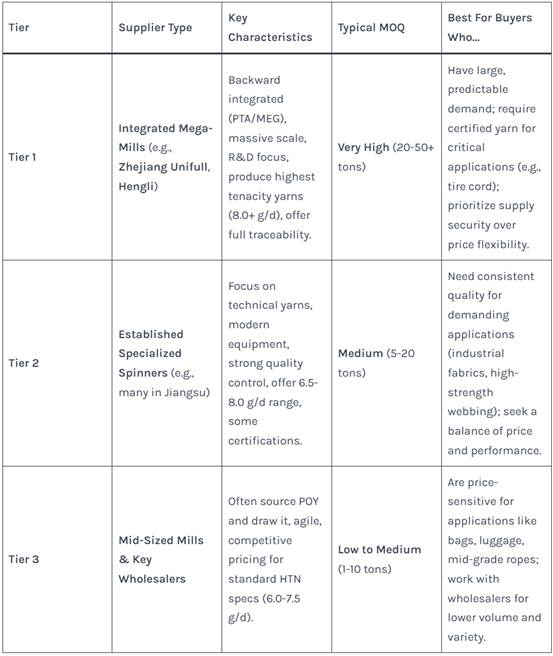
- Direct Sales from Major Integrated Manufacturers: Companies like Zhejiang Unifull or Jiangsu Hengli Chemical Fiber sell directly to large-volume, established global buyers (MOQs often >20 tons).
- Specialized Industrial Yarn Wholesalers/Traders: These companies, such as Shanghai Huitong International Trade or regional specialists, aggregate demand. They offer lower MOQs (1-5 tons), provide logistical support, consolidate orders, and offer a wider product portfolio from multiple mills. They are the primary gateway for small to medium-sized international buyers.
- Sourcing Agents: Act as intermediaries for buyers without a local presence, handling everything from supplier identification to quality inspection for a commission.
4. Major Wholesalers and Manufacturers: A Tiered Analysis
It is crucial to understand the tiered nature of the market to align suppliers with your needs.
Table 1: Tiered Analysis of Chinese HTN Yarn Suppliers
5. Specifications, Grades, and Technical Data: Decoding the Product Sheet
When sourcing HTN yarn, the technical datasheet is your contract. Here are the critical parameters:
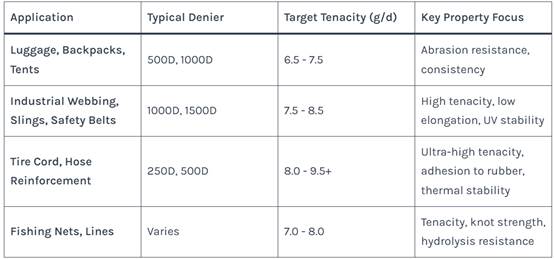
- Denier: Standard industrial deniers include 250D, 500D, 1000D, 1500D.
- Tenacity (g/d or cN/dtex): The core specification. 6.0-7.0 g/d is standard for luggage; 7.0-8.0 g/d for premium webbing; 8.0-9.5+ g/d for tire cord & high-performance composites.
- Elongation at Break (%): Must be low and consistent.
- Thermal Shrinkage (%): Important for downstream thermal setting processes.
- Oil Content: Affects processability in weaving or coating.
- Grades: Often unofficially categorized as Industrial Grade, Premium/High-Performance Grade, and Tire Cord Grade.
Table 2: Typical Specification Ranges by Application
6. Pricing Dynamics and Cost Structure Analysis
HTN yarn prices are more stable than textile yarn but are influenced by:
- Raw Material Costs (PTA & MEG): The primary driver.
- Specification Premium: Every 0.5 g/d increase in tenacity can add a 3-8% price premium.
- Order Volume & Relationship: Long-term contracts secure better rates.
- Exchange Rate (USD/CNY): A key factor for international quotes.
Typical Price Range (FOB China, 2024):
- Standard 1000D/7.0 g/d: $1.60 – $1.90/kg
- Premium 1000D/8.0 g/d: $1.90 – $2.30/kg
- Tire Cord 500D/9.0 g/d: $2.40 – $2.80/kg
7. Strategic Sourcing: A Guide for Different Buyer Profiles
- For Large-Volume Industrial Buyers: Target Tier 1 manufacturers directly. Invest in factory audits. Negotiate annual framework agreements with quarterly pricing reviews. Prioritize technical support and co-development.
- For SMEs and New Market Entrants: Partner with reputable Tier 3 wholesalers or specialized traders. Leverage their lower MOQs and market knowledge. Use them to sample from multiple mills. Clearly define all technical specs in your purchase order.
- For Brand-Owned Supply Chains: Consider a hybrid model: use a Tier 2 spinner for dedicated, consistent supply of your proprietary yarn specification, managed through a trusted sourcing agent for quality oversight.
8. Quality Assurance, Inspection, and Risk Mitigation
Never buy based on a datasheet alone.
- Pre-Shipment Inspection: Mandatory. Hire a third-party (e.g., SGS, Bureau Veritas) to test for tenacity, elongation, denier, and evenness against your PO specs at the factory warehouse.
- Certifications: For critical applications, request mill-specific test reports. ISO 9001 is common; specific product certifications are rarer but ask.
- Sample Approval: Before bulk production, obtain and test physical yarn samples on your own equipment if possible.
- Contract Clarity: Specify exact test methods (e.g., ASTM D885 for tire yarn), acceptable tolerances, and penalties for non-conformance.
9. Logistics and Supply Chain Considerations
HTN yarn is typically shipped on wooden spools or in cardboard cones, packed in cartons on pallets. Ensure your supplier uses robust, moisture-resistant packaging. Standard sea freight in 20′ or 40′ containers is most cost-effective. Lead times:
- From stock (wholesaler): 2-3 weeks for shipping.
- Production lead time (mill): 4-8 weeks for standard specs; longer for custom orders.
10. Future Trends and Industry Outlook
- Green and Recycled HTN Yarn: Growing demand for high-tenacity yarn made from recycled PET (rPET) flakes for sustainable bags, webbing, and non-critical industrial uses. This is a nascent but fast-growing niche.
- Ultra-High Molecular Weight Polyester: Development of yarns with tenacity exceeding 10 g/d for next-gen composites and ballistics.
- Digitalization: Blockchain for traceability and digital platforms for smoother transactions between wholesalers and international clients.
11. Building a Reliable Sourcing Channel
Sourcing high-tenacity polyester filament yarn from China is a process that rewards diligence and strategic partnership. Success lies not in finding the cheapest supplier, but in identifying the right type of supplier whose capabilities, scale, and quality ethos match your application’s critical demands. By thoroughly understanding the technical landscape, leveraging the wholesale ecosystem appropriately, and implementing rigorous quality controls, you can transform Chinese manufacturing power into a durable competitive advantage for your products.
12. Frequently Asked Questions (FAQ)
Q1: Can I get small sample quantities (e.g., 5-10 kg) for R&D before placing a bulk order?
A: Yes, but typically not directly from large mills. Specialized wholesalers or traders are your best bet for small samples. They often have sample stocks or can arrange small runs from cooperative mills for a fee.
Q2: What is the difference between high-tenacity and high-modulus polyester yarn?
A: They are closely related but distinct. High-Tenacity refers to the maximum stress (strength) the yarn can withstand before breaking. High-Modulus refers to its resistance to stretching under low stress (stiffness). HTN yarn has high tenacity; true high-modulus polyester is a more specialized, often higher-priced product.
Q3: How does the quality consistency of Chinese HTN yarn compare to European or US producers?
A: Top-tier Chinese mills (Tier 1, and many Tier 2) produce yarn that is fully competitive in terms of technical specifications and consistency. The perceived gap has closed significantly. The key is supplier qualification—many Western tire manufacturers source directly from these top Chinese mills. Inconsistent quality is more a risk with smaller, uncertified Tier 3 suppliers.
Q4: Are there any import duties or restrictions on this product in the EU or USA?
A: High-tenacity polyester filament yarn generally faces standard import duties. In the EU, it falls under specific tariff codes. There are currently no broad anti-dumping duties on Chinese HTN yarn as there are for some standard textile yarns, but this should always be verified with a customs broker as policies change.
Q5: What is the standard payment term for a first order with a new Chinese wholesaler?
A: For a first order, expect 30% deposit by T/T, 70% balance against copy of Bill of Lading. Letters of Credit (LC) are also common but add cost. Established relationships may move to more open terms.
Q6: Can I request custom denier or tenacity specifications outside standard ranges?
A: Yes, but this moves you into the realm of customized production, which is only feasible with manufacturers (Tiers 1 & 2), not wholesalers holding stock. This entails significant MOQs (often 20+ tons), a development process, and a price premium.
Q7: What’s the lead time for a custom-color high-tenacity yarn?
A: This is a specialized and expensive process. Adding color (solution dyeing) to HTN yarn requires specific masterbatches and process adjustments. Lead times can extend by 6-10 weeks, and MOQs are high. It is not commonly stocked.
Q8: Who are the key competitors to China in the global HTN yarn market?
A: On a volume and cost basis, China faces limited direct competition. South Korea (e.g., Hyosung) and Taiwan produce high-quality, often premium-priced HTN yarns. India is a growing producer, often competitive in the mid-range market. For ultra-premium niches, European and US specialty producers still hold market share.